Understanding PDUs in Data Centers
Data centers require consistent, reliable power distribution to keep servers and network equipment operating without interruption.
At the heart of this electrical infrastructure is the Power Distribution Unit (PDU). PDUs ensure stable power delivery from the facility’s electrical system to each rack, server, and critical device.
What Is a PDU?
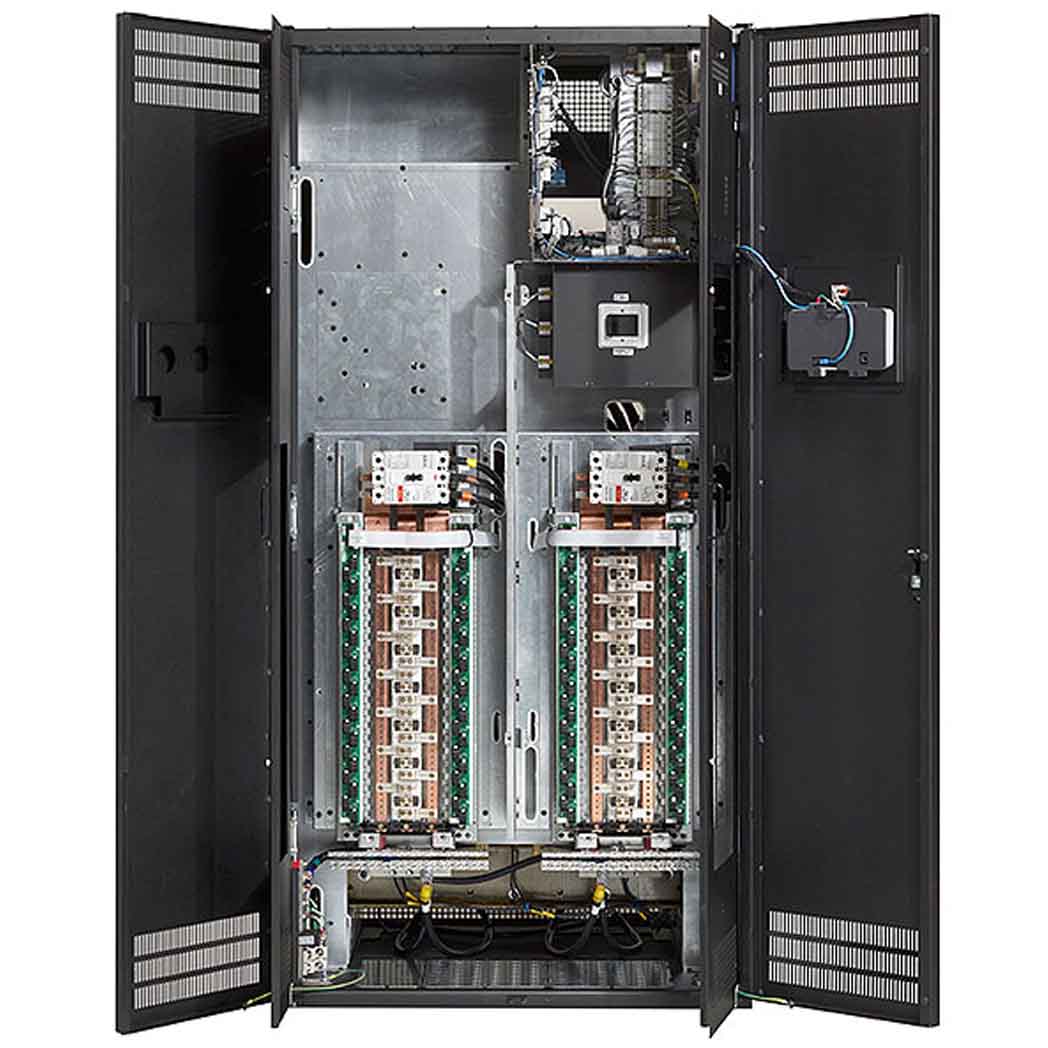
A Power Distribution Unit (PDU) is an electrical device that distributes power from a primary source to multiple downstream components.
In data centers, PDUs connect the uninterruptible power supply (UPS) or main power feed to server racks and equipment.
They act as the bridge between high-voltage input and low-voltage output, ensuring safe and organized power flow to multiple devices.
How PDUs Work
-
Input Power – The PDU receives power from a utility feed, generator, or UPS system.
-
Voltage Transformation – Some PDUs step down or regulate voltage to match the equipment’s operating requirements.
-
Distribution – The PDU channels electricity through multiple protected outlets or breakers to individual servers and devices.
-
Monitoring and Control – Smart PDUs measure current, voltage, and energy use in real time for efficient management.
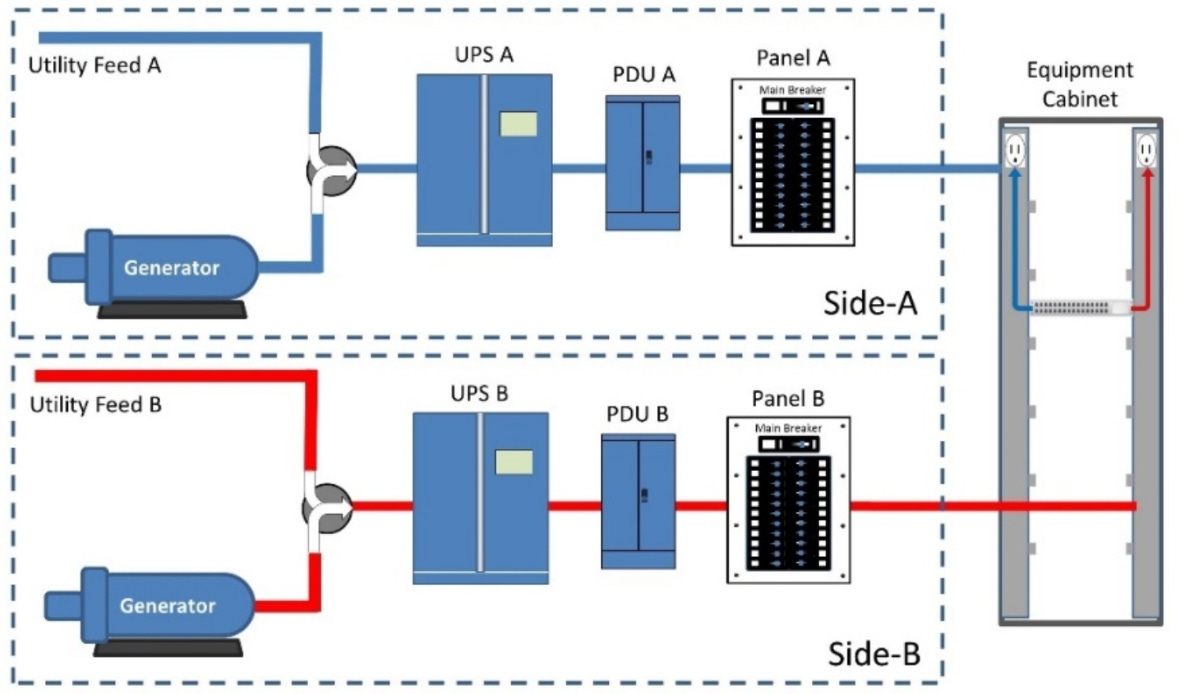
By distributing and monitoring electrical power, PDUs maintain uptime and improve energy efficiency across critical systems.
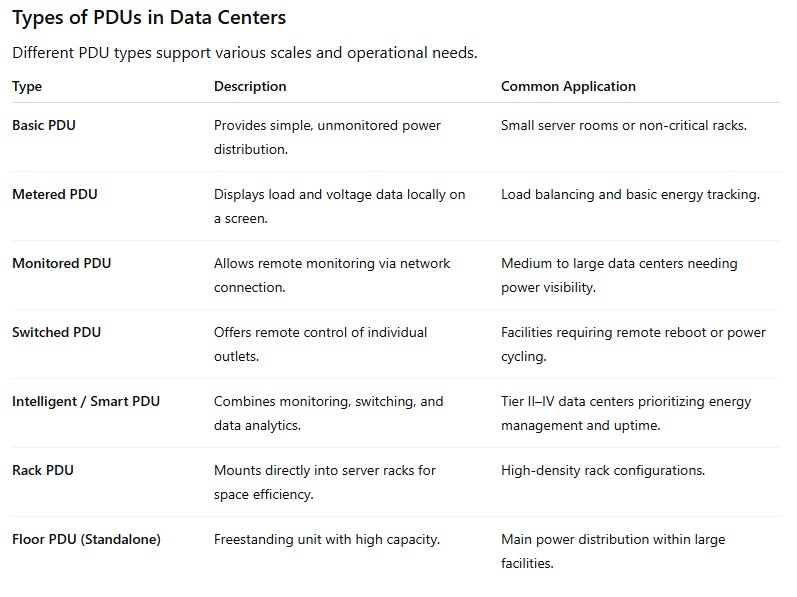
Key Components of a PDU
-
Circuit breakers – Protect connected equipment from overloads or short circuits.
-
Input power cable – Delivers power from the UPS or main panel.
-
Output receptacles – Supply power to servers and networking hardware.
-
Meters and sensors – Measure power draw, temperature, and environmental conditions.
-
Network interface – Enables remote monitoring and control through data center infrastructure management (DCIM) software.
Advantages of PDUs in Data Centers
PDUs provide organized, efficient, and scalable power distribution for high-density data centers.
They help prevent overloads, balance electrical loads, and improve operational visibility.
Smart PDUs also collect energy data, allowing operators to optimize rack density and reduce overall power consumption.
Design Considerations for PDUs
When designing a data center, engineers must size PDUs to handle expected load with redundancy.
They should match the PDU’s voltage, amperage, and plug types to server and UPS specifications.
Placement matters—rack PDUs should align with cable management systems for airflow efficiency.
Moreover, remote monitoring should integrate with the building management system (BMS) or DCIM for real-time alerts and analytics.
PDU Applications in Tier I–IV Data Centers
-
Tier I – Basic PDUs distribute power from a single source with minimal redundancy.
-
Tier II – Metered PDUs provide load visibility for better capacity management.
-
Tier III – Intelligent PDUs integrate with dual power paths and UPS systems for fault tolerance.
-
Tier IV – Fully monitored PDUs support redundant paths and real-time energy optimization.
As the data center tier increases, so does the need for smarter, more resilient power distribution systems.
Integration With Other Systems
PDUs work alongside UPS units, generators, and remote power panels (RPPs) to maintain power reliability.
They form part of the broader electrical backbone, which also includes transfer switches, breakers, and monitoring platforms.
This integration ensures that even during maintenance or power loss, connected servers remain operational.
Conclusion
PDUs are the backbone of data center power management.
They ensure continuous and organized power delivery, enabling reliable performance for mission-critical systems.
As energy efficiency becomes increasingly important, smart PDUs play a growing role in optimizing load balance and uptime across modern facilities.