
Designing for Flexibility: How Adaptive Spaces Are Shaping the Future of Multifamily Housing
Why Flexibility Matters More Than Ever
Today’s multifamily residents expect more from their spaces. Units are no longer just places to live—they function as offices, gyms, and social hubs. As a result, developers and designers must rethink how spaces perform over time. Flexible design is no longer a luxury; it is a necessity.
At EVstudio, integrated architecture and engineering allow teams to anticipate these evolving needs early in the design process. By doing so, projects can adapt to changing lifestyles without requiring costly renovations later.
Designing Spaces That Do More
Flexible multifamily design starts with intentional planning. Open floor plans remain important, but flexibility goes beyond simply removing walls. Instead, it focuses on how spaces can transform throughout the day.
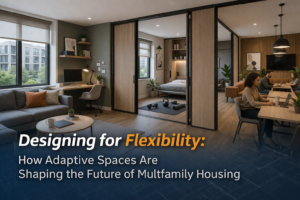
For example, movable partitions, multifunctional furniture, and adaptable layouts allow residents to customize their environment. A living room can quickly shift into a workspace, while shared amenity areas can support both social and professional uses.
Additionally, designing with clear structural grids and coordinated systems ensures future modifications are easier to implement. This approach supports long-term value for both owners and residents.
The Role of Offsite and Modular Construction
Offsite construction plays a major role in delivering flexible housing solutions efficiently. Modular systems allow for repeatable, scalable designs that can still accommodate customization.
Because components are fabricated in controlled environments, teams can maintain quality while reducing construction timelines. At the same time, modular design supports adaptability. Units can be configured, expanded, or replicated depending on project needs.
This aligns closely with EVstudio’s approach to integrated design, where collaboration across disciplines ensures flexibility is built into every phase of the project.
Future-Proofing Multifamily Developments
Future-proofing is about designing with change in mind. While no one can predict exactly how residents will use spaces in ten years, thoughtful design strategies can prepare buildings to evolve.
For instance, incorporating accessible infrastructure for future technology, designing amenity spaces with multiple use cases, and prioritizing durability all contribute to long-term success. These decisions not only improve resident experience but also protect investment value.
Ultimately, flexible design supports sustainability by reducing the need for frequent renovations and minimizing material waste over time.
Building for What’s Next
Multifamily housing continues to evolve, and flexibility is at the center of that transformation. By integrating architecture, engineering, and construction strategies, EVstudio delivers spaces that perform today and adapt for tomorrow.
Designing for flexibility is not just about meeting current demands—it is about creating resilient environments that grow alongside the people who use them.