
Hyperscale Data Centers in Space: The Future of Computing Beyond Earth
Artificial intelligence is transforming the world. However, AI requires enormous computing power, electricity, and cooling capacity.
As demand grows, some companies are looking beyond Earth for solutions.
Today, several organizations are exploring hyperscale data centers in space. Their goal is simple. Move computing closer to unlimited solar energy while reducing terrestrial infrastructure constraints.
Although the concept sounds futuristic, active development is already underway.
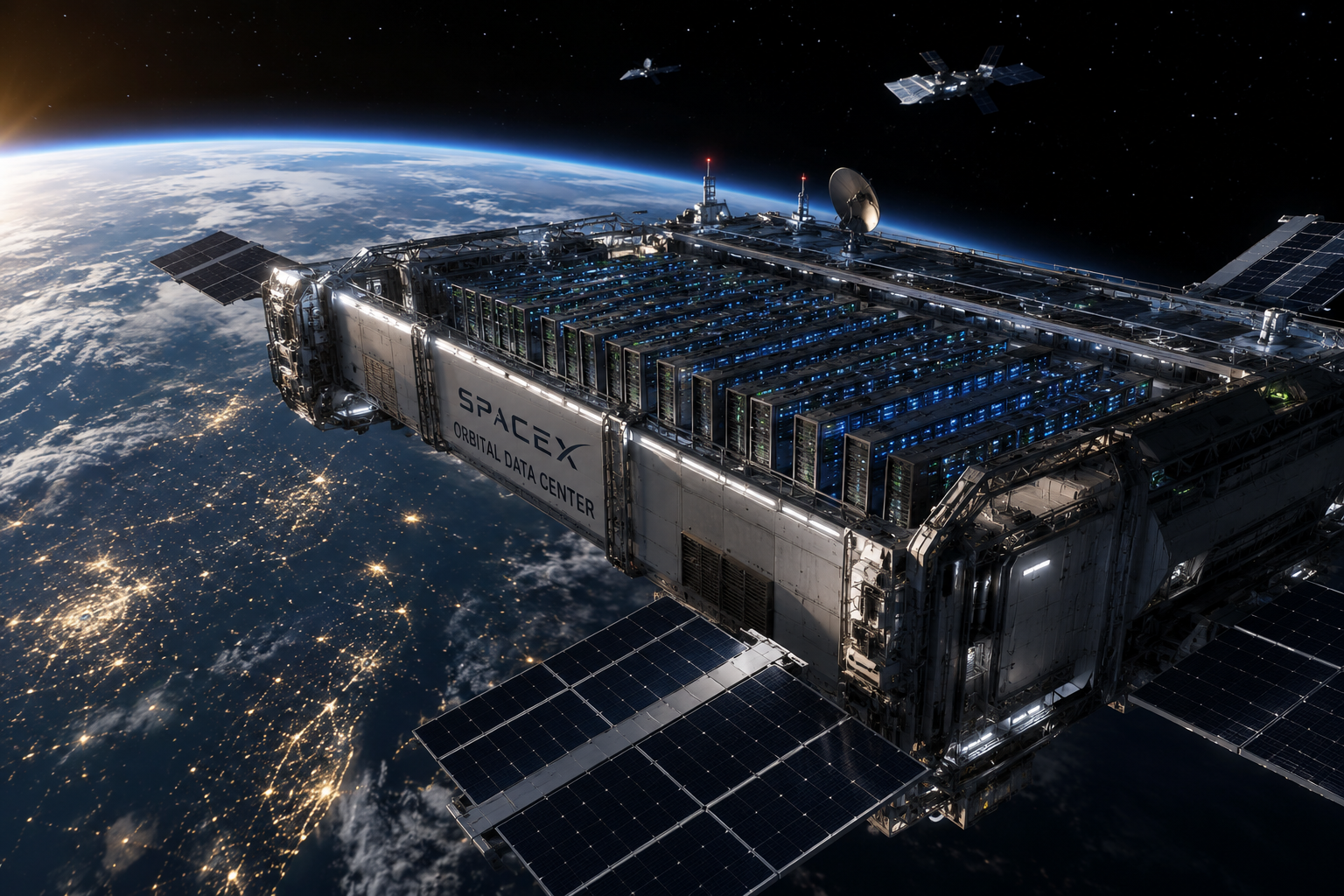
What Is a Space-Based Data Center?
A space-based data center places servers, storage systems, and networking equipment in orbit.
Instead of processing all data on Earth, satellites perform computing tasks in space.
As a result, operators can reduce transmission requirements and process information closer to its source.
Some concepts focus on small orbital computing platforms. Others envision massive solar-powered computing campuses in orbit.
Who Is Exploring Orbital Data Centers?
Several organizations are leading development efforts.
Axiom Space
Axiom Space has launched orbital data center demonstrations and continues expanding its space computing capabilities.
The company envisions distributed computing networks operating in low Earth orbit.
Starcloud and Crusoe
Starcloud and Crusoe are developing AI-focused orbital computing platforms.
Their vision centers on large-scale AI processing powered by space-based solar energy.
European ASCEND Program
The European Union’s ASCEND initiative is studying the feasibility of large orbital data centers.
Researchers are evaluating environmental, technical, and economic impacts.
Lonestar Data Holdings
Lonestar plans to locate secure data storage systems on the Moon.
Initially, the company targets disaster recovery and long-term archival storage.
SpaceX
SpaceX has emerged as one of the industry’s most ambitious players.
The company has discussed concepts involving up to one million computing satellites.
These satellites would function as a distributed cloud computing network in orbit.
SpaceX believes orbital computing could eventually overcome several challenges facing terrestrial AI infrastructure.
The company also possesses a unique advantage.
Unlike competitors, SpaceX controls launch services, satellite manufacturing, and communications infrastructure.
Additionally, Starlink already operates thousands of satellites with onboard computing systems.
As Starship matures, launch costs could decline dramatically.
Consequently, orbital data centers may become economically viable at unprecedented scales.
Why Move Data Centers Into Space?
Several factors drive interest in orbital computing.
Virtually Unlimited Solar Energy
Space-based systems receive sunlight almost continuously.
Therefore, they avoid weather interruptions and nighttime power losses.
Future facilities could generate enormous amounts of renewable energy.
Reduced Demand on Electrical Grids
Many utilities struggle to support new hyperscale AI facilities.
Orbital data centers could reduce pressure on terrestrial power infrastructure.
Elimination of Land Constraints
Traditional data centers require large sites, substations, and transmission infrastructure.
Orbital facilities eliminate those requirements entirely.
Space-Based Data Processing
Satellites generate massive amounts of data every day.
Orbital computing allows operators to process information before transmitting results to Earth.
As a result, communication networks become more efficient.
Major Challenges Remain
Despite its promise, orbital computing faces significant obstacles.
Launch Costs
Launching computing equipment remains expensive.
Although costs continue falling, economics remain challenging.
Thermal Management
Space is cold, but cooling electronics remains difficult.
Engineers must reject heat through large radiator systems.
Unlike Earth, space provides no air for conventional cooling.
Radiation Exposure
Cosmic radiation can damage electronic components.
Therefore, designers must harden equipment for long-term operation.
Maintenance Challenges
Technicians cannot simply visit orbital facilities.
Future systems may require robotic maintenance and autonomous repairs.
Unproven Business Models
Even SpaceX acknowledges uncertainty regarding commercial viability.
The industry still needs to prove long-term economic benefits.
What Could This Mean for Architecture and Engineering?
The implications extend far beyond aerospace.
Historically, architects and engineers designed data centers around terrestrial constraints.
Projects focused on utility power, cooling systems, land use, and building codes.
Orbital facilities introduce entirely different design challenges.
Future space-based campuses may require expertise in:
- Thermal radiator systems
- Solar energy collection
- Structural systems for microgravity
- Autonomous maintenance systems
- Modular construction
- High-density computing infrastructure
- Robotic assembly methods
Many solutions may eventually influence Earth-based projects.
For example, advanced cooling technologies could improve terrestrial data center efficiency.
Similarly, modular construction methods may evolve from technologies developed for orbital deployment.
The industry’s design priorities could shift dramatically.
Instead of optimizing for land use, utility interconnections, and mechanical cooling plants, designers may optimize for launch mass, solar collection efficiency, and thermal radiation systems.
In many ways, orbital data centers represent an entirely new building typology.
The Future of Computing
Orbital data centers will not replace terrestrial facilities anytime soon.
Instead, the industry will likely adopt a hybrid approach.
Earth-based hyperscale campuses will continue supporting most workloads.
Meanwhile, orbital systems will process satellite data, AI workloads, and space-based communications.
Over time, declining launch costs may change that equation.
If fully reusable launch vehicles achieve their goals, the economics could shift rapidly.
The computing industry has already evolved from mainframes to cloud computing.
Orbital computing may represent the next major transformation.
Although significant challenges remain, the question is no longer whether computing can happen in space.
Instead, the industry is increasingly asking how quickly it can scale.
References:
- Axiom Space Orbital Data Centers: https://www.axiomspace.com/orbital-data-center
- Axiom Space Orbital Data Center Program: https://www.axiomspace.com/release/axiom-space-to-launch-orbital-data-center-nodes-to-support-national-security-commercial-international-customers
- ASCEND Program: https://ascend-horizon.eu
- Thales Alenia Space ASCEND Study: https://www.thalesaleniaspace.com/en/press-releases/thales-alenia-space-reveals-results-ascend-feasibility-study-space-data-centers-0
- Lonestar Data Holdings: https://lonestar.com
- SpaceX Orbital Computing Discussions: https://www.reuters.com/world/spacex-says-unproven-ai-space-data-centers-may-not-be-commercially-viable-filing-2026-04-21/
- SpaceX Million Data Center Satellites Concept: https://cosmiclog.com/2026/01/31/spacex-wants-to-launch-a-million-data-center-satellites/
- Multi-Orbit Data Center Research: https://arxiv.org/abs/2603.18601
- Space-Based Data Center Policy Analysis: https://project-disco.org/innovation/space-based-data-centers-bringing-ai-policy-into-the-equation/