
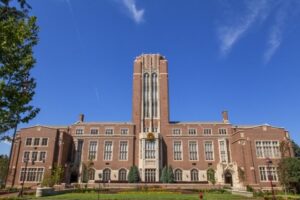
The University of Denver stands as Colorado’s oldest private university. It boasts a rich campus filled with historic architecture and enduring landmarks. One of these treasures is Mary Reed Hall, a building that connects past and present in an unforgettable way.
A Legacy Built on Generosity
Mary Reed Hall was completed in 1932 and opened in early 1933. It replaced the older Carnegie Library, offering an expanded space for the university’s growing collections. The building was funded through the generosity of Mary D. Reed, a prominent Denver philanthropist.
Mary Reed’s husband, Verner Reed, made his fortune in mining, banking, ranching, and irrigation after moving to Colorado. After Verner’s death in 1919, Mary Reed invested deeply in her community, giving a substantial donation to support the construction of this library.
Designed in the Collegiate Gothic style, Mary Reed Hall drew on the architectural traditions of medieval universities. Its tall central tower and detailed stonework quickly made it one of the most iconic structures on campus.
Learn more about its history at the University of Denver’s official field notes.
Architecture That Inspires
Mary Reed Hall exemplifies Collegiate Gothic architecture, a style meant to evoke timeless scholarship and grandeur. Its brick facade and limestone trim reflect the era’s attention to craftsmanship and permanence.
The building’s central tower, visible across campus, has become a symbol of the university. It appears on stationery, graduation announcements, class rings, and other memorabilia.
Inside, the hall originally served as a library. It housed reading rooms filled with natural light and featured ornate details like Gothic arches, wrought-iron railings, and terrazzo stairways. These design elements helped create spaces that encouraged learning, reflection, and community.
A New Chapter: Renovation and Renewal
Over the decades, Mary Reed Hall’s interior and function evolved. When the Penrose Library (now Anderson Academic Commons) opened in 1972, Mary Reed Hall was repurposed to house administrative offices and other uses.
Most recently, the architectural and engineering firm EVstudio completed thoughtful renovations to the historic landmark. These updates respected the building’s iconic Collegiate Gothic design while improving functionality.
EVstudio’s work ensured that the renovations were both respectful of the original architecture and responsive to modern needs. The project improved interior spaces while preserving Mary Reed Hall’s architectural legacy.
According to EVstudio, these renovations help guarantee that Mary Reed Hall will continue to serve as a vibrant and integral part of the University of Denver community for years to come. Explore the renovation project in detail here.
A Living Landmark on Campus
Today, Mary Reed Hall is more than a beautiful old structure. It is a hub of administrative activity, communal engagement, and university tradition. It houses offices, meeting spaces, and venues that serve students, faculty, and staff.
The building connects the campus visually and historically to the rich story of DU’s growth. Its presence reminds students and visitors of the university’s long-standing commitment to education, culture, and community.
Why Mary Reed Hall Matters
-
It reflects decades of architectural and educational history at the University of Denver.
-
It honors the generosity of Mary D. Reed, whose philanthropy made it possible.
-
Renovations by EVstudio preserve its legacy while preparing it for future use.
-
It remains a living, breathing part of campus life—an anchor for community and tradition.
Mary Reed Hall stands as a testament to the power of thoughtful preservation, where history and progress walk hand in hand, and where every brick tells a story of purpose and pride.


