
Architectural Styles: Shingle & Tudor
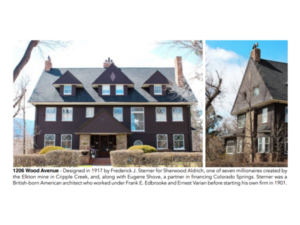
Shingle Style:
The Shingle style is an American architectural style of the late 1800s. The main emphasis is on horizontal lines and the exterior visual of a flat, shingled façade. The style draws inspiration from both English architecture—particularly the work of Richard Norman Shaw—and the renewed interest during this time in American Colonial architecture.
Shingle style shares many elements with the contemporaneous Richardson Romanesque style, named for architect Henry Hobson Richardson of Massachusetts. It shows an affinity for Romanesque arches and irregular, sculpted shapes. It also borrows elements from the Queen Anne style, with wide porches, asymmetrical forms, and shingled surfaces.
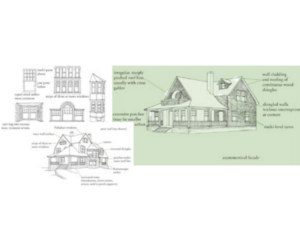 Rather than the highly ornamented exteriors of Eastlake or Queen Anne styles, Shingle style aims to make its statement through tight simplicity and massing proportions. It aspires for the effect of a complex shape contained within a smooth envelope. Innovative architects and firms including William Ralph Emerson, McKim, Mead & White, and Peabody and Stearns designed massive “seaside cottages’’ for wealthy family summer homes. The style became especially popular in New England, primarily in East Hampton, Long Island, Newport, Rhode Island, Cape Cod, and coastal Maine.
Style Characteristics:
Wood shingles are the primary surface material of this style, applied to the exterior to emphasize the flat planes and massing without interruption by corner boards. Some architects, in order to give new buildings a more weathered look, would dip cedar shakes in buttermilk before applying them, giving buildings a gray tint.
Tudor Style:
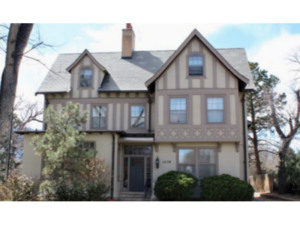
The popular name for the Tudor style is historically imprecise. Relatively few examples closely mimic the architectural characteristics of Tudor (16th-century) England. The style evolved from a variety of late Medieval and early Renaissance English prototypes. Example houses ranged from thatch-roofed folk cottages to grand manors. This broad variety provided the basis for a well-publicized English domestic architecture revival that began around 1850 and lasted until 1930.
British architects such as Phillip S. Webb (1831–1915), C. F. A. Voysey (1857–1941), M. H. Baillie Scott (1865– 1945), and Sir Edwin Lutyens (1869–1944) produced homes that were imitated both in the U.S. and Great Britain. Beginning about 1880, the publisher B. T. Batsford of London advanced this revival by publishing numerous books containing photographs, measured drawings, and drawings of old English homes, which were distributed in the U.S.. In 1911 they published The Domestic Architecture of England During the Tudor Period by Thomas Garner and Arthur Stratton, perhaps the style’s best sourcebook.
A Brief History:
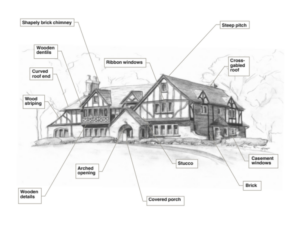
American revivalist expressions put emphasis on steeply pitched, front-facing gables that, although absent on many original English prototypes, are almost universally present in American Tudor houses. The earliest American houses in the style date from the late 19th century. These tended to be architect-designed landmarks that closely copied English models. Mostly patterned after late Medieval buildings with Renaissance detailing. These details were popular during the reigns of Elizabeth I (1558– 1603) and James I (1603–1625), the Elizabethan and Jacobean eras of English history.
Architecture historians have proposed the contracted term “Jacobethan” for these early Tudor landmarks. Most fall into the parapeted-gable subtype described above. Less pretentious Tudor houses from 1900 to 1920 joined the Tudor landmarks of the 1890s. These houses superimposed half-timbering and other typical detailing upon symmetrical facades or simple gables with wing forms. Tudor Style was still relatively uncommon before World War I. It exploded in popularity during the 1920s with masonry veneering techniques. Then the most modest examples to mimic closely the brick and stone exteriors seen on English prototypes.
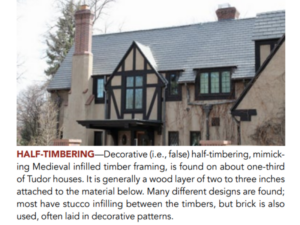
Style Characteristics:
They display endless variations in overall shape and roof forms. It is not uncommon for the character of Tudor-style homes to vary geographically. Wall materials greatly influence the appearance of style. For example, nearby availability of a particular stone or brick can impart a distinct local character. Second, respected local architects and their approach to Tudor design affected the style in a neighborhood or an entire town.
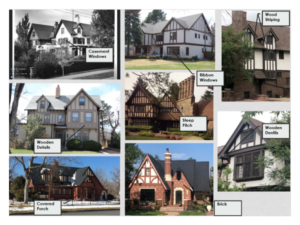 Tudor style features a variety of materials and detailing. The picturesque and asymmetrical Tudor offered architects great versatility in floor planning. The house plan could rule the design rather than its being dictated by symmetry. This freedom allowed rooms to be oriented in any direction and windows to be placed where needed. The simple inclusion of wings only one room deep. Rooms could be two stories high with wings placed at an angle. Tudor style even allowed studios, service rooms, and attached garages effortlessly incorporated into the design. In addition to its early English roots, the style may incorporate details from America’s contemporaneous Craftsman houses.
Source:
A Field Guide to American Houses: The Definitive Guide to Identifying and Understanding America’s Domestic Architecture, by Virginia Savage McAlester


