Seeing Development from Both Sides
For more than 15 years, I have served as a volunteer on the Westminster Planning Commission. My profession, however, is civil engineering. Over the course of my career, I have spent countless hours presenting projects before planning commissions and city councils across Colorado.
Experiencing the development process from both sides of the dais has given me a unique perspective on how communities grow and how decisions get made.
Balancing Property Rights and Community Planning
My philosophy as a Planning Commissioner is simple: all else being equal, property owners should have the freedom to use their land as they choose.
However, the phrase “all else being equal” carries significant weight.
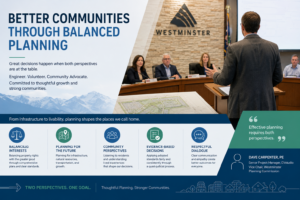
Communities adopt comprehensive plans and development codes to balance individual property rights with broader public interests. These documents are not always arbitrary. They represent years of public input, technical analysis, and long-term planning.
As a civil engineer, I see firsthand why that planning matters.
In the western United States, growth decisions are inseparable from infrastructure capacity and natural resources. Water supplies depend on mountain snowpack. Transportation networks require long-term investment. Parks and open spaces must be protected. Utility systems need to serve both today’s residents and tomorrow’s growth.
Comprehensive plans provide the roadmap for those decisions. They create predictability for residents, certainty for property owners, and a clearer path for applicants pursuing new development.
Understanding the Role of the Planning Commission
One of the biggest misconceptions about planning commissions is that commissioners can simply approve or deny projects based on personal preference.
In reality, planning commissions operate in a quasi-judicial role. Commissioners must base decisions on the evidence in the record and the standards established in the municipal code and comprehensive plan. We cannot rewrite the code during a hearing, nor can we rely on information gathered outside the public process.
Even when commissioners support a project in principle, we may have no choice but to deny an application that does not meet the adopted criteria.
Another common misconception is that commissioners are city employees or elected officials. We are neither.
Planning commissioners are volunteers. We are community members who dedicate our time because we care deeply about the future of our city.
Engineering Perspective and Public Input
My engineering background has helped me better understand the concerns raised by both commissioners and the public. Residents are experts in their own lived experience. They know where traffic backs up, where water ponds after a storm, and how their neighborhoods have changed over time.
Those observations matter.
At the same time, one of the commission’s responsibilities is distinguishing between concerns caused by a proposed project and issues that already exist.
Sometimes a drainage concern identifies a long-standing problem that a new development may help solve. Sometimes traffic concerns reflect broader regional growth patterns that an individual project cannot reasonably address.
The Importance of Communication
As an engineer representing applicants, I understand how difficult it can be to answer challenging questions about projects that teams have spent months designing and refining. Successful presentations require more than technical expertise. They require listening, empathy, and the ability to explain complex issues in accessible terms.
The most effective public hearings are grounded in clear expectations, respectful dialogue, and a shared commitment to applying the adopted standards fairly.
A Shared Goal
Whether I am sitting at the applicant table or on the commission dais, I have learned the same lesson: effective planning requires both perspectives.
Dave Carpenter is a Professional Engineer and a Senior Project Manager with EVstudio and serves as Vice Chair of the Westminster Planning Commission. He has more than 26 years of experience in civil engineering and land development.