
Engineering for the Factory Floor: Navigating M/P Coordination in Modular Design
The financial case for modular construction relies entirely on repeatability and the reduction of on-site labor hours. However, from an engineering perspective, shifting a building from a field-erected structure to a series of factory-built modules introduces rigid spatial constraints. While a wall assembly or structural frame can be readily standardized, Mechanical and Plumbing (M/P) systems present a high level of physical complexity due to unyielding code compliance, strict routing tolerances, and fluid dynamics.
To capture the true affordability of offsite manufacturing, M/P systems cannot be adapted to a modular layout after the fact. The mechanical and plumbing infrastructure must actively dictate the module logic from the earliest schematic phases.
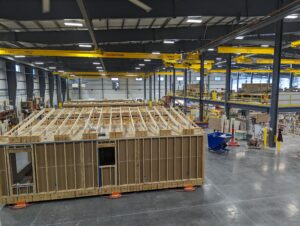
The Cost of Deferred Coordination: Moving Clash Detection Upstream
In traditional design-bid-build delivery, detailed routing and spatial coordination are often deferred to the shop drawing or construction administration (CA) phase. In a modular framework, this sequence introduces severe financial risk.
Discovering a structural interference—such as a 4-inch horizontal drainage line clashing with a primary module chassis beam—is a minor field correction on a traditional job site. On a factory assembly line, it halts production, invalidates pre-assembled components, and incurs compounding idle labor costs.
True affordability is achieved by shifting heavy multi-discipline coordination early in the design process. By establishing clear structural boundaries, module mating lines, and utility corridors early, engineers can design system configurations that are optimized for rapid factory assembly and minimal field tie-ins.
Critical Engineering Strategies for Cost-Effective M/P Integration
Optimizing M/P infrastructure for modular efficiency requires a shift away from traditional, distributed layouts toward centralized, high-density system design:
-
- Centralized Utility Trunks and Chase Management: Instead of running plumbing and mechanical lines through distributed wall spaces, systems should be consolidated into dedicated, centralized utility trunks. This minimizes the number of service penetrations across module joints (mating lines). Reducing the total number of field connections directly cuts down on high-cost site labor during the rigging and setting phases.
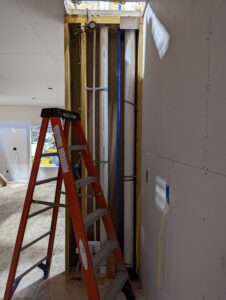
- Centralized Utility Trunks and Chase Management: Instead of running plumbing and mechanical lines through distributed wall spaces, systems should be consolidated into dedicated, centralized utility trunks. This minimizes the number of service penetrations across module joints (mating lines). Reducing the total number of field connections directly cuts down on high-cost site labor during the rigging and setting phases.
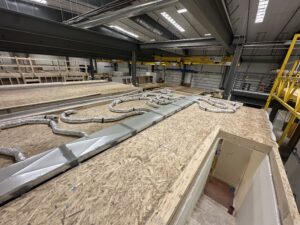
- Integrating Split Systems and Line Sets: Mini-splits and low-profile, ceiling-concealed fan coil units offer excellent room-by-room temperature control, but their layout requires tight geometric planning. Engineers must map the routing of refrigerant line sets and specify the locations of multi-port branch boxes during early design. This ensures that equipment fits perfectly within the structural framing and minimizes the number of mechanical connections that must cross the module joints during final assembly.
- Managing Gravity Slopes and Framing Clearances: Unlike flexible electrical wiring, plumbing drains and mechanical condensate lines depend entirely on gravity. They require unyielding, code-mandated slopes (typically 1/4-inch per foot) to function safely. M/P engineers must collaborate with structural designers early to ensure that floor joist directions and header depths can physically accommodate these sloped runs, preventing unexpected drops in ceiling heights or field modifications.
Engineering Perspective
The affordability of modular construction is not achieved by sacrificing system quality or cutting materials; it is earned through upfront coordination. When M/P engineers establish clear utility corridors and strict structural parameters from day one, the mechanical and plumbing infrastructure becomes a driver of project velocity rather than a source of late-stage change orders.