Frank Lloyd Wright vs. Le Corbusier: Nature and the Machine in Modern Architecture
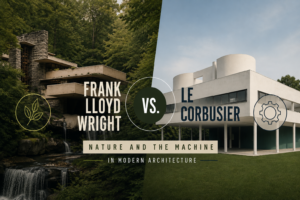 Few rivalries in architectural thought are as influential as the contrast between Frank Lloyd Wright and Le Corbusier. Both helped define modern architecture in the twentieth century, yet their visions could hardly have been more different. At its core, the divide was between nature and machine, organic growth and rational order.
Two Philosophies of Modernity
Frank Lloyd Wright believed that architecture should emerge naturally from its surroundings. He called this approach organic architecture, arguing that buildings should harmonize with the landscape, local climate, and materials of a place. Rather than imposing a structure on the environment, Wright sought to create a seamless relationship between the two.
Le Corbusier took a very different view. Famous for describing the house as a “machine for living in,” he embraced industrialization, standardization, and efficiency. His inspiration came less from nature and more from engineering, technology, and the possibilities of modern manufacturing.
The Relationship Between Building and Landscape
The contrast becomes especially clear in how each architect treated nature. Wright designed buildings that blended into their surroundings. His masterpiece Fallingwater, for example, is built directly over a waterfall, making the natural setting an integral part of the architectural experience.
Le Corbusier often separated architecture from the ground itself. Through the use of pilotis—slender columns that lifted buildings above the landscape—he created structures that stood apart from nature rather than merging with it. Villa Savoye remains one of the clearest expressions of this idea.
Form, Style, and Spatial Experience
Wright favored horizontal lines, open floor plans, and natural materials such as stone and wood. His interiors feel warm, human-scaled, and closely connected to the surrounding environment.
Le Corbusier, by contrast, pursued geometric clarity and functional order. His architecture is characterized by white volumes, flat roofs, structural grids, and a restrained aesthetic that minimized ornament. The emphasis was on rational design and efficiency rather than emotional connection to place.
Competing Visions of the City
Their differences extended beyond individual buildings to the future of urban life. Wright imagined a decentralized society through his Broadacre City proposal, where people would live in low-density communities with closer access to nature and open land.
Le Corbusier envisioned the opposite. His Radiant City concept proposed dense, highly organized urban centers composed of tall towers, strict planning, and carefully controlled circulation systems designed to maximize efficiency.
Materials and Technology
Although both architects embraced modern materials, they used them in different ways. Wright employed new technologies while maintaining a sense of craftsmanship and connection to local conditions. His buildings often felt unique and rooted in place.
Le Corbusier fully embraced reinforced concrete, mass production, and modular systems such as the Modulor. He sought universal design principles that could be applied broadly, reflecting his belief in architecture as a rational solution to modern living.
The Lasting Divide
In many ways, Wright and Le Corbusier represent two enduring paths within modern architecture. Wright championed nature, individuality, and harmony with the environment. Le Corbusier championed the machine, standardization, and efficiency.
Both were pioneers whose ideas transformed architecture around the world. Yet they pushed modernism in nearly opposite directions—Wright toward the earth and the organic qualities of place, and Le Corbusier toward abstraction, industry, and the logic of the modern machine.