The Most Expensive Square Foot in a Building Isn’t What You Think
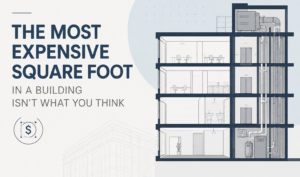 When people think about construction costs, they usually focus on the overall price per square foot. However, experienced architects, engineers, and developers know that not every square foot costs the same to build.
In fact, some of the most expensive areas of any building are surprisingly small.
Mechanical rooms, elevator shafts, restrooms, kitchens, utility chases, and circulation corridors all contain an incredible amount of infrastructure. Plumbing, electrical systems, HVAC equipment, fire protection, structural support, and accessibility requirements come together in these compact spaces. As a result, these areas often cost significantly more per square foot than offices, apartments, classrooms, or other occupied spaces.
That is why thoughtful planning during the earliest stages of design is so important.
Designing for Efficiency
A well-designed building does more than maximize square footage—it maximizes usable square footage. Every square foot used for building systems is one that owners cannot lease, sell, or occupy.
At EVstudio, our architecture, structural, civil, MEP, surveying, and landscape architecture teams work together from the beginning of every project. This integrated approach helps identify opportunities to reduce unnecessary space dedicated to infrastructure while maintaining performance, safety, and code compliance.
In many cases, relocating a mechanical room, consolidating plumbing stacks, or improving structural coordination creates additional rentable or functional space without increasing the building’s footprint.
Small Decisions, Big Savings
Although these design decisions may seem minor, they can significantly affect both construction costs and the long-term value of a building.
Even a slight improvement in unit efficiency can increase the amount of rentable square footage across an entire multifamily development.
Commercial buildings also benefit from optimized service areas that create more flexible tenant spaces.
In educational, healthcare, and municipal facilities, efficient layouts improve daily operations while reducing maintenance requirements and simplifying future renovations.
Making these decisions early in the design process is critical because changes on paper are far less expensive than modifications made during construction.
Collaboration Makes the Difference
Many project inefficiencies develop when design disciplines work independently. Structural systems may compete with ductwork. Plumbing layouts can interfere with framing. Equipment sometimes requires more space than originally planned.
By bringing multiple disciplines together under one roof, EVstudio’s teams resolve coordination challenges throughout the design process instead of discovering them in the field. Early collaboration reduces conflicts, minimizes costly revisions, and keeps projects moving forward.
The result is a building that functions more efficiently, makes better use of available space, and delivers greater long-term value for owners and occupants alike.
The most valuable square foot in a building is not necessarily the largest room or the most eye-catching feature. Instead, it is every square foot that has been carefully planned to work smarter. Thoughtful coordination today creates buildings that perform better for decades to come.