Why Surveyors Get Blamed First — And Why That’s a Bad Idea
 On a construction site, when something doesn’t line up, one reaction is almost guaranteed: “Must be a survey problem.”
It’s a familiar refrain for anyone in land surveying. The surveyor is often the first person to be blamed when an error appears in the field — even before the issue is understood. But this knee-jerk reaction isn’t just unfair. It creates blind spots, slows down problem-solving, and undermines the collaborative mindset that complex projects require.
The Visibility Trap: Why Surveyors Become the Default Target
Surveyors are the first professionals to translate design into physical reality. We put stakes in the ground, set control, and define the geometry that everyone else builds from. Because our work is the first tangible step, it becomes the easiest place to point when something looks off.
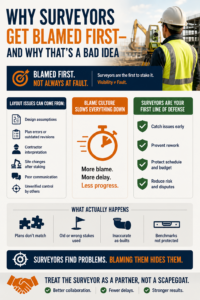
But visibility is not the same as fault. A layout issue can originate from:
• Design assumptions that don’t match field conditions
• Plan errors or outdated revisions
• Contractor interpretation of layout marks
• Site changes made after staking
• Missing communication between teams
• Unverified control established by others
Yet the surveyor is the first questioned because our work is the first seen.
The Real Problem: Blame Culture Slows Down Solutions
When the default response is to blame the surveyor, teams lose valuable time. Instead of diagnosing the issue objectively, energy gets spent defending positions. That delays the one thing that really matters: fixing the problem before it becomes expensive.
What Actually Happens When an Issue Appears
Experienced surveyors know that when something doesn’t fit, the cause is often upstream. A few common examples:
• A foundation layout doesn’t match the plans because the architectural and structural
drawings don’t align.
• A contractor builds off old stakes that were never meant to be used for construction.
• A utility conflict appears because the as-builts were inaccurate.
• A grading crew cuts to the wrong elevation because benchmarks weren’t protected.
In each case, the surveyor is the first questioned — even when the root cause is far
outside the survey scope.
Why That’s a Bad Idea: Surveyors Are Your First Line of Defense
Surveyors are uniquely positioned to catch issues before they become costly. But that only works when they’re treated as partners, not suspects.
When surveyors are empowered to speak up, they can:
• Identify design inconsistencies early
• Flag constructability issues before crews mobilize
• Verify control and prevent cascading errors
• Protect the project from rework, delays, and disputes
Blaming the surveyor first shuts down the very expertise that protects the project.
The Bottom Line
Surveyors aren’t the cause of most field errors — they’re the ones who find them. Blaming them first doesn’t just miss the mark. It slows down the project, damages collaboration, and hides the real issues that need attention. Treat the surveyor as a partner, not a scapegoat. Your schedule, your budget, and your quality control will all thank you.