Designing Production Housing for Today’s Homebuyer
The profile of today’s homebuyer has shifted dramatically over the past decade. No longer driven solely by square footage or bedroom count, buyers are increasingly evaluating homes through the lens of lifestyle, flexibility, and long-term adaptability. Demographic changes, evolving work patterns, technological advancements, and rising expectations around wellness and sustainability have fundamentally reshaped what people want from their homes and neighborhoods. For production housing studios, this evolution presents both a challenge and an opportunity: how to design communities that resonate deeply with modern buyers while maintaining scalability, efficiency, and affordability.
Designing for How People Actually Live
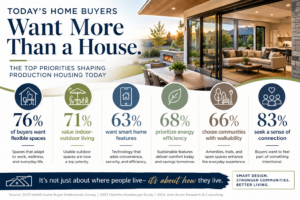
Modern buyers expect homes that reflect how they live day-to-day—not idealized versions of life. The rise of remote and hybrid work, for example, has transformed the importance of flexible spaces. Dedicated home offices, once considered a luxury, are now often essential. Even more important, however, is adaptability—spaces that can evolve from office to guest room, fitness area, learning space, or hobby room over time.
Open-concept layouts remain popular, but buyer preferences have become more nuanced. Homeowners increasingly seek subtle zoning strategies—visual or spatial cues that define functions without sacrificing openness. Features such as partial walls, ceiling treatments, built-in storage, and transitional spaces help create distinct living areas while preserving a sense of connection throughout the home.
Additionally, buyers are placing greater emphasis on storage, organization, and efficient floor plans. Homes that feel intentional and well-considered often create a stronger emotional response than larger homes with wasted space. Design decisions that support everyday routines—from drop zones near entries to smart pantry layouts—can significantly improve the living experience.
Bringing the Outdoors In
Another defining expectation is a seamless relationship between indoor and outdoor living. Buyers are placing higher value on usable outdoor space—covered patios, courtyards, outdoor kitchens, and landscaped areas that function as true extensions of the home.
This shift reflects a broader desire for wellness, relaxation, and connection to nature. Outdoor living spaces provide opportunities for entertaining, family gatherings, and personal retreat while increasing the perceived size and functionality of the home. Even in more compact production housing environments, thoughtful design can maximize outdoor enjoyment through private courtyards, pocket parks, and strategically placed community green spaces.
In production housing, careful placement of windows, sliding glass doors, and transitional materials can dramatically enhance this connection without significantly increasing construction costs. These design strategies improve natural light, strengthen views, and create a stronger sense of openness—all factors that contribute to perceived value and overall homeowner satisfaction.
Technology and Sustainability Matter
Today’s homebuyer has also become more informed and technology-driven. Smart home features are increasingly viewed as expectations rather than upgrades. Integrated security systems, smart thermostats, energy monitoring tools, and connected appliances enhance convenience while helping homeowners manage costs more effectively.
At the same time, sustainability has become an important purchasing consideration. Buyers are paying closer attention to energy efficiency, durable building materials, indoor air quality, and water conservation measures. Features such as high-performance insulation, efficient HVAC systems, low-maintenance landscaping, and energy-saving appliances are often viewed as long-term investments rather than optional amenities.
For builders and designers, incorporating sustainable strategies early in the planning process can create meaningful value while helping communities remain competitive in an increasingly educated marketplace.
Communities as Extensions of the Home
Today’s buyers are also selecting communities, not just houses. Walkability, shared amenities, educational opportunities, and access to recreation all play a growing role in decision-making. In many cases, the neighborhood experience can be just as important as the home itself.
As a result, site planning has become as critical as floor plan design. Successful communities create a sense of cohesion while offering variety—inviting streetscapes, meaningful public spaces, gathering areas, trails, and a recognizable identity. Buyers want to feel that they are part of something intentional, connected, and well-designed.
Community amenities no longer need to be extravagant to be impactful. Thoughtfully designed parks, open spaces, dog parks, community gardens, and pedestrian-friendly connections often deliver significant lifestyle value. The goal is to create environments that encourage interaction, foster belonging, and support daily life.
Experience Over Square Footage
Perhaps the most important takeaway is that buyers are prioritizing experience over raw metrics. A well-designed 2,200-square-foot home that lives efficiently and feels purposeful will often outperform a larger but less thoughtful design. Functionality, comfort, flexibility, and emotional connection increasingly outweigh sheer size.
This trend signals an important evolution for the housing industry. Success is no longer defined solely by providing more square footage or additional features. Instead, it requires a deeper understanding of how people live, work, connect, and adapt over time.
The EVstudio Approach
For EVstudio’s Production Housing Studio, this shift reinforces the importance of design leadership that balances market insight, operational efficiency, and exceptional livability. Our team understands that successful production housing is not simply about delivering homes at scale—it is about creating thoughtful environments that enhance the daily lives of residents while supporting our builder partners’ business objectives.
By integrating flexible floor plans, community-focused planning, architectural character, and cost-conscious design strategies, EVstudio helps builders respond to evolving buyer expectations without sacrificing profitability or speed to market. As homebuyers continue to prioritize lifestyle, wellness, and connection over traditional metrics, our Production Housing Studio remains focused on designing homes and neighborhoods that are not only market-ready today but adaptable for the needs of tomorrow.