 Building Smarter: How AI Is Transforming the AECO Industry
Published June 25, 2026 | Architecture · Engineering · Construction · Operations
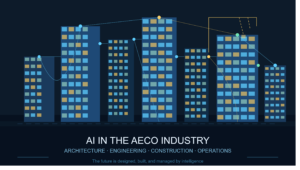
Artificial intelligence is no longer a future promise for the built environment. Today, AI actively reshapes every phase of a building’s life — from the first sketch to decades of daily operations. The Architecture, Engineering, Construction, and Operations (AECO) industry stands at a turning point. Teams that embrace AI gain speed, precision, and a decisive competitive edge. Those that hesitate risk falling behind in a rapidly evolving market.
This post explores how AI drives real, measurable change across each of the four AECO disciplines.
Architecture: Designing the Future, Faster
AI fundamentally changes how architects conceive and develop buildings. Generative design tools now rapidly explore thousands of design options based on specific parameters. Consequently, architects evaluate far more ideas in far less time than ever before.
Moreover, AI-powered Building Information Modeling (BIM) provides real-time updates throughout the design process. These enhanced BIM tools improve coordination and reduce costly errors before ground breaks. Architects use AI to optimize layouts, materials, and structural logic simultaneously — a task that once took weeks.
Importantly, AI does not replace the architect. Instead, it amplifies human creativity and judgment. As Autodesk’s research confirms, 76% of AECO organizations plan to increase AI investment over the next three years. AI handles the computational heavy lifting, freeing architects to focus on innovation and client vision.
VR and AR tools, powered by AI, also allow clients to walk through a building before a single wall rises. This capability transforms client communication and reduces revision cycles significantly.
Key tools and resources:
Engineering: Smarter Analysis, Safer Structures
AI transforms how engineers analyze complex systems and manage project data. Large Language Models (LLMs) now process contract clauses, technical specifications, and risk assessments with remarkable speed. As a result, engineering teams make better decisions faster and with greater accuracy.
Structural health monitoring also advances dramatically with AI integration. Convolutional Neural Networks extract nuanced features from vibration and acoustic data, detecting subtle damage indicators that human inspectors might miss. Engineers visualize crack progression and stress concentrations in real time through digital twin environments.
Furthermore, AI-enabled digital twins connect design data to live performance data. These systems continuously run simulations in the background, acting as active decision engines rather than passive dashboards. Engineers gain the ability to observe structural behavior as it evolves — and intervene before problems escalate.
For civil infrastructure specifically, AI manages increasingly complex data volumes. AI has become a natural step in taming the tsunami of digital data generated by modern engineering projects.
Key tools and resources:
- ASCE: AI Adoption in AEC
- MDPI: AI-Enabled Digital Twins in the Built Environment
- LLMs in AECO: Application Scenarios
Construction: Safer Sites, Sharper Schedules
On the job site, AI delivers some of its most visible and impactful results. Computer vision systems now monitor sites continuously through cameras, drones, and wearable devices. These systems detect fall hazards, missing PPE, and unauthorized access to dangerous zones — then immediately alert managers. AI-powered vision-based safety systems are rapidly becoming a new standard for proactive safety management.
Additionally, AI revolutionizes project scheduling and cost forecasting. Project teams move beyond static Gantt charts to dynamic AI-driven “what-if” analysis. Planners quickly test schedule disruptions, resource reallocations, and sequencing adjustments in minutes rather than days.
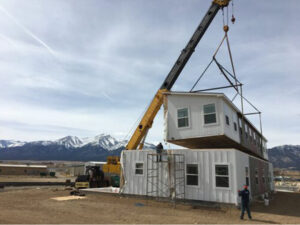
Modular construction also benefits enormously from AI optimization. Bechtel’s AI agents now break projects into installation work packages in minutes or hours instead of days or weeks. As site conditions change, AI updates these packages quickly to reflect new parameters.
Beyond scheduling, 56% of AEC professionals believe AI will help compensate for the ongoing skilled labor shortage by making existing workers substantially more productive.
Key tools and resources:
- Autodesk: 2026 AI Construction Trends
- ENS Design Group: AI Transforming AEC
- BIM Home Studio: BIM Trends 2026
Operations: Buildings That Think for Themselves
Once construction wraps, AI continues to deliver value through the entire operational life of a building. Digital twin technology now transitions from static 3D replicas to intelligent, data-driven systems that integrate real-time analytics. The global digital twin market is projected to reach $49.47 billion in 2026 — a clear signal that facility managers take this technology seriously.
These intelligent twins run thousands of background simulations continuously. They analyze HVAC systems, elevators, and electrical grids to predict failures before they occur. As a result, building owners dramatically reduce reactive maintenance costs and improve occupant comfort and safety.
AI also drives significant sustainability outcomes in building operations. GenAI applications reduce energy consumption and optimize maintenance decisions across commercial and residential portfolios. In urban environments, AI assists with higher-level decision-making, even controlling traffic flow to reduce emissions.
Facility managers now access a “what-if” engine rather than a passive dashboard. This shift from reactive to predictive management represents one of the most powerful transformations AI delivers across the full AECO lifecycle.
Key tools and resources:
- SAMEX: Digital Twin in Facility Management 2026
- MDPI: GenAI in AECO — Systematic Review
- Build in Digital: The AI-Powered Future of AECO
The Road Ahead
AI in AECO is not a single technology. Rather, it is a connected ecosystem of tools that links design, construction, operations, and facility management into one intelligent workflow. The industry shifts from document-driven processes to continuous, data-driven decision-making — treating the full project lifecycle as a single, connected system.
The barriers to adoption are not primarily cost. Instead, they are complexity, culture, and connection. Firms that invest in training, integrate data strategies, and build AI-ready workflows will lead the next decade of the built environment.
Ultimately, AI will not replace architects, engineers, builders, or facility managers. It will strengthen every one of them — and build a better world in the process.
Further reading: