
Understanding MSE Walls: A Cost-Effective Retaining Wall Solution
In site development and land planning, earth retention plays a critical role in shaping the built environment. Typically designed by structural and geotechnical engineers, retaining systems make it possible to create roads, bridges, building sites, and other infrastructure on challenging terrain. Whether for large-scale transportation projects, commercial developments, or residential properties, there are many methods available to stabilize soil and manage changes in elevation. One of the most common solutions is the Mechanically Stabilized Earth (MSE) wall.
Earth retention has been used for thousands of years, but modern systems such as MSE walls have become widely adopted only since the 1960s and 1970s. Today, these systems offer an efficient and economical way to create stable slopes and retaining structures while accommodating a variety of site conditions.
At their core, MSE walls consist of alternating layers of granular or structural backfill and reinforcing materials. Depending on the system manufacturer, the reinforcement may include steel wire mesh, steel grids, steel rods, or geosynthetic products such as geogrids and geotextiles. These reinforcement layers are connected to the wall facing, allowing the reinforced soil mass and facing system to work together to resist loads and retain earth.
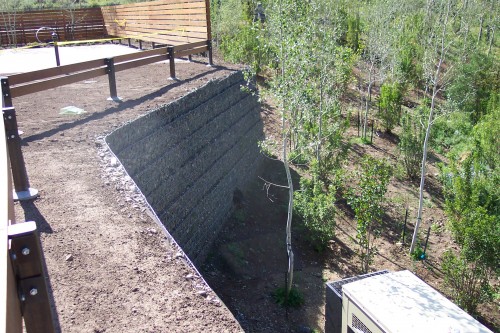
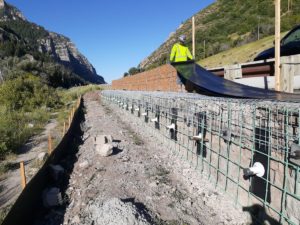
As an example, the residential project shown below utilizes a steel wire mesh MSE wall to support a driveway. In this application, the wall facing is also constructed of wire mesh, which promotes excellent drainage by allowing water to move freely through the granular backfill and exit the system. This solution provided a cost-effective alternative to extending and wrapping the driveway around the natural topography. As a result, the project was able to preserve more of the site’s native landscape while minimizing construction impacts.
EVstudio designs retaining walls for a wide range of project types, helping clients evaluate the most effective solution based on site conditions, performance requirements, aesthetics, and budget. MSE walls are often an attractive option because of their versatility, durability, and cost efficiency.
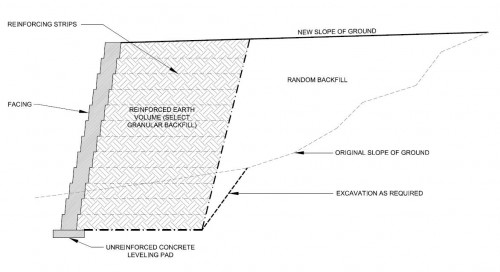
To help illustrate how these systems work, EVstudio developed the graphic below showing the basic design principles behind an MSE wall. While each MSE wall manufacturer utilizes proprietary materials and engineering specifications, the fundamental concepts remain largely the same. The cross-section diagram provides a simplified representation of how the reinforced soil mass, facing elements, and retained earth work together to create a stable retaining structure.
Our Engineering department has a team specializing in various earth retention projects and systems. For small residential projects to large Department of Transportation projects please reach out for your engineering needs.
For additional information and example projects check out Integrated Wall Solutions website to learn more about various retaining walls from the contractor’s viewpoint.



2 thoughts on “Mechanically Stabilized Earth (MSE) Wall”
How many panels can be typically erected per day?
-Thanks-
Good Post. Structural engineers are also used to design retaining walls. EVstudio’s Structural department has designed retaining walls using concrete, CMU, MSE, boulders and landscaping blocks by various manufacturers.
Comments are closed.