Jefferson County ULUC 2026: Key Zoning Changes, Concerns, and What Residents Should Know
Jefferson County is preparing a major rewrite of its land use regulations. The proposed Unified Land Use Code, or ULUC, would govern unincorporated Jefferson County. The ULUC addresses zoning, subdivisions, setbacks, parking, landscaping, water, fire protection, ADUs, short-term rentals, and development review. These rules affect homeowners, businesses, property owners, developers, and neighboring residents.
The County’s overall goal makes sense. Jeffco wants one clearer code instead of several overlapping regulatory documents. I support that goal. However, a rewrite this large should improve existing problems, not simply reorganize them. It should also protect public participation, existing property rights, and neighborhood character. After reviewing the hearing draft, I believe several issues still deserve attention.
The Jefferson County ULUC Process
I have participated directly in Jefferson County’s land use regulation process for years. I served on the County’s Regulation Advisory Panel, commonly called the RAP. That group became the ULUC Advisory Committee as Jeffco moved toward this comprehensive rewrite. I remain an active participant on that committee. My perspective also comes from professional practice. I am both a licensed architect and professional engineer.
My firm regularly works with zoning, entitlements, site planning, infrastructure, and redevelopment regulations. We see how regulatory language affects real properties and real communities. That experience gives me a practical perspective on the proposed ULUC. I also see where well-intended regulations create unintended consequences. This article reflects my professional review and personal perspective. It does not represent an official ULUC Advisory Committee position.
What Is the Jefferson County Unified Land Use Code?
The ULUC represents the final regulatory phase of the broader Together Jeffco planning effort. That effort updated several major County planning documents. Those documents include the Comprehensive Plan, Transportation and Mobility Plan, and major wildfire planning documents. Jeffco adopted its updated Comprehensive Plan in April 2026. The ULUC now converts many planning policies into enforceable regulations. The regulations would apply throughout unincorporated Jefferson County.
Incorporated cities such as Lakewood, Arvada, Golden, and Westminster maintain their own separate zoning regulations. The proposed ULUC does not replace those municipal codes. Jeffco says the ULUC will combine and update its zoning and development regulations. It also addresses development review procedures and numerous land use standards.
Where the ULUC Process Stands Now
Jefferson County released a revised hearing draft after the formal referral comment period. Staff revised several provisions following community and stakeholder feedback.
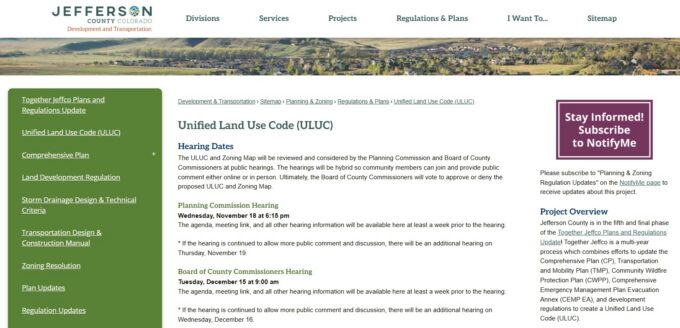
The Planning Commission hearing is scheduled for November 18, 2026, at 6:15 p.m. A continuation may occur on November 19. The Board of County Commissioners hearing is scheduled for December 15, 2026, at 9:00 a.m. A continuation may occur on December 16.
The County still accepts additional comments. However, staff says those comments will not change the draft before the hearings. That makes the hearing process especially important. The Commissioners will ultimately decide whether to adopt the ULUC and proposed zoning map.
The ULUC Does Much More Than Consolidate Existing Rules
The ULUC does not simply combine existing documents. It makes several significant policy changes across Jefferson County.
The proposal expands housing choices within several existing residential districts. Jeffco describes this approach as “gentle density.” Duplexes would become allowed within R-1, R-1A, R-1B, and R-1C districts. Those districts generally allow single-family homes today. Triplexes would also become allowed within R-2 under specified lot requirements. The County also proposes a new R-1D residential district. R-1D would allow single-family lots as small as 1,200 square feet. However, the district only affects properties where Jeffco actually applies that zoning. Detached accessory dwelling units would no longer require a 7,500-square-foot minimum lot. Owner occupancy and other ADU restrictions would remain.
The ULUC also simplifies many zoning categories. Commercial zoning becomes C-C, C-N, and C-R. Mixed-use zoning becomes MU-1 and MU-2. Industrial zoning also consolidates into three primary categories. The County proposes eliminating several existing districts. Affected properties would receive new zoning classifications intended as close replacements.
The ULUC also changes subdivision approval procedures. A new Minor Plat process would cover subdivisions containing 12 lots or fewer. The Planning Director could approve those subdivisions administratively. The process would not require automatic Planning Commission or Commissioner hearings. The proposal also strengthens water testing and water-supply rules. It modifies fire access, agricultural standards, and development review procedures.
Many of these changes have legitimate policy goals. Some could improve housing choices and regulatory efficiency. However, several changes deserve closer examination before adoption.
By-Right Housing Density Deserves Careful Review
Housing represents one of the most significant policy changes within the ULUC. Jeffco wants more housing types within existing neighborhoods. That approach has clear benefits. Duplexes, triplexes, and ADUs can support families, aging residents, and smaller households. However, these changes occur through zoning itself. Future projects may therefore avoid individual rezoning hearings. Residents should understand that distinction. A by-right project does not require the same neighborhood discussion as a rezoning. The County should also evaluate cumulative infrastructure impacts. More housing units can affect parking, traffic, utilities, schools, and drainage.
Those impacts vary greatly across Jefferson County. Established areas with full infrastructure can absorb growth differently than constrained areas. The County should match increased density with demonstrated infrastructure capacity. It should also explain where existing infrastructure can support these changes.
Mixed-use zoning raises similar questions. MU-1 requires residential minimum densities when a project includes housing. Mountain MU-1 requires at least five units per acre. Plains MU-1 requires at least ten units per acre. MU-2 requires at least fifteen units per acre. MU-1 also includes a twenty-unit-per-acre maximum.
These policies may work well in appropriate locations. The zoning map therefore matters as much as the written code.
Twelve-Lot Subdivisions Could Avoid Public Hearings
The proposed Minor Plat process creates another significant change. Jeffco wants to simplify smaller subdivision approvals. Today, subdivisions generally receive Planning Commission and County Commissioner hearings. Even simple land divisions can require lengthy review. The ULUC would allow administrative approval for developments containing 12 lots or fewer. Staff would still review the application and notify neighbors. However, neighbors would not receive an automatic public hearing. The Planning Director could refer a project to hearings when necessary.
Efficiency matters. A simple two-lot family land division should not require unnecessary months of process. However, a 12-lot subdivision can create meaningful neighborhood impacts. It can affect traffic, drainage, emergency access, utilities, and nearby properties. The County should consider objective triggers requiring public hearings. Those triggers could address traffic, drainage, emergency access, neighborhood compatibility, or substantial public concern.
There is another related question. Jeffco says park and school requirements continue for subdivisions containing more than 12 lots. That policy deserves closer examination. Smaller developments still create cumulative demands on parks, schools, roads, and public services.
More Decisions Move to Administrative Staff
The ULUC moves several decisions from public boards toward administrative approval. That change can make routine development faster. Administrative review can also improve predictability for applicants. However, administrative discretion needs clear boundaries. The ULUC allows Administrative Exceptions to several development standards. Proposed setbacks can receive reductions reaching 50 percent during specified development processes. Parking requirements can also receive reductions reaching 50 percent. Building height may receive additional administrative relief. The Planning Director can also evaluate land uses not specifically listed within the code. Staff may approve a use when it sufficiently resembles an allowed use.
The code requires staff to consider scale, intensity, impacts, compatibility, and Comprehensive Plan consistency. That flexibility can help the code adapt over time. However, residents need transparent and objective decision standards. Jeffco should clearly define when administrative decisions require heightened public review. The appeal process should also remain practical and accessible.
Efficiency should not eliminate meaningful public participation.
Existing Nonconforming Properties Still Face Redevelopment Risks
Jefferson County contains many older buildings and properties. Many existed before current zoning regulations.Those properties may contain legal setbacks, uses, or configurations that no longer comply. The ULUC generally allows legal nonconforming buildings to remain. However, redevelopment can trigger more difficult requirements. The Site Development Plan language creates a particularly important concern.
The draft states that nonconforming uses or structures must become conforming before Site Development Plan approval. That provision can affect older commercial, industrial, institutional, and multifamily properties. An owner may only want to improve one site component. The approval process could force unrelated existing conditions into compliance. That requirement may discourage investment in older properties.
Jeffco should distinguish harmful nonconformities from harmless historic conditions. The code should encourage safe improvements to older properties.
Commercial Zoning Still Does Not Fit Many Main Street Environments
This issue became especially clear during my review of Downtown Evergreen. However, the principle applies to other Jeffco Activity Centers. Traditional Main Street environments place buildings close to sidewalks. They use smaller parcels, compact blocks, and pedestrian-oriented development. Conventional suburban setbacks do not support that pattern.
Jeffco reduced its proposed commercial setbacks following public comments. The changes show that the County recognized part of the concern. Commercial Neighborhood zoning dropped from 40 feet to 30 feet. Commercial Convenience dropped from 35 feet to 25 feet. Commercial Regional dropped from 50 feet to 40 feet.
Those reductions help, but they do not solve the underlying problem.
A 30-foot front setback still does not describe a historic Main Street. It continues to separate buildings from pedestrians. The proposed ULUC already contains more pedestrian-oriented tools. MU-1 uses a build-to standard near primary streets. MU-1 generally requires significant building frontage within ten feet of the street. It also permits common-wall buildings with zero side setback.
Jeffco should apply similar principles within designated Activity Centers. The County could use overlays, contextual setbacks, or Main Street zoning. The zoning should reflect the places that actually exist.
The Five-Acre Planned Development Minimum Remains a Critical Problem
The proposed Planned Development rules require at least five acres for new PD zoning. Jeffco wants to discourage unnecessary customized zoning. I understand that objective. However, many unique commercial and infill properties contain far less than five acres. Those sites may not fit a standard zoning district. This problem becomes especially serious within older Activity Centers.
Jeffco responded directly to this concern for Downtown Evergreen. The October hearing draft now exempts that Activity Center from the acreage minimum. The draft states that Downtown Evergreen properties have no minimum acreage requirement for PD zoning. That change represents meaningful progress. It also validates the underlying concern.
I found no comparable exception for other Activity Centers within the October redlines. The logic should apply consistently. Similar small parcels can face the same problem elsewhere in Jefferson County.
Jeffco should extend the exemption to designated Activity Centers. The County should also consider other constrained infill locations.
At minimum, every property needs a practical path toward permanent zoning entitlement appropriate for their context.
Disaster Reconstruction Rules Improved, But Questions Remain
The October hearing draft also improves reconstruction rules for legal nonconforming buildings. This represents another positive response to public comments. Earlier language used a 50-percent threshold based on appraised market value. The revised draft uses 75 percent of gross square footage. The draft also adds special protection for historically significant buildings. Those buildings can receive additional time and original reconstruction rights.
However, the historic reconstruction language should become clearer. The code should explicitly address complete destruction. A fire, flood, or other disaster should not permanently erase a historic development pattern. Jeffco should also consider similar protection for legally established buildings inside designated Activity Centers.
Health, safety, floodplain, and wildfire regulations should still apply. Reconstruction rights can coexist with those protections.
Some Jeffco Properties Will Receive New Zoning
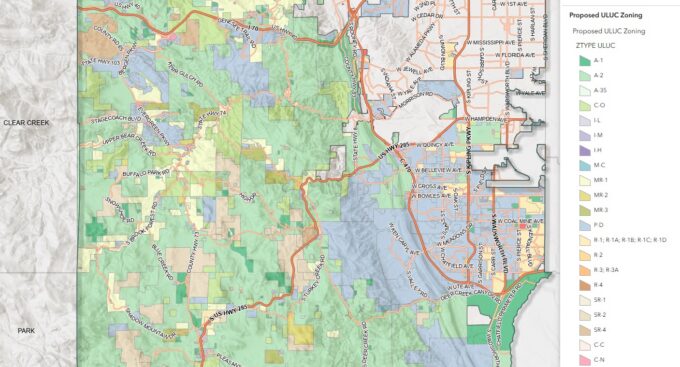
Most properties in unincorporated Jefferson County will not change zoning districts. However, some existing zoning categories will disappear. Jeffco will assign affected parcels to new districts. The County describes those replacements as the closest match to current zoning. A closest match does not necessarily provide identical rights. Allowed uses, setbacks, density, or procedures can still change.
Every affected owner should compare the current zoning with the proposed zoning. Owners should not rely only on a new district name. Jeffco provides an interactive map and a list of properties receiving zoning changes. This review matters before adoption. Property owners should understand any change to development rights before it becomes permanent.
New Water Rules Add Protection, Cost, and New Questions
The proposed ULUC strengthens both water-quality and water-supply requirements. These changes offer important public health benefits. Private well testing would include uranium, radium, arsenic, manganese, nitrates, E. coli, and several other contaminants. The County may require mitigation when results exceed applicable standards. Jeffco also strengthens 100-year water-supply requirements for groundwater-dependent development. The County describes water availability as a key growth constraint.
These policies deserve support in principle. However, implementation details matter greatly. Property owners need predictable testing standards and clear mitigation requirements. They also need to understand costs before investing in a project.
Jeffco should avoid introducing major uncertainty at the building permit stage. Applicants need early answers about potential water limitations.
Land Use Rules Are Changing Before Technical Manuals Finish Updating
The timing of the ULUC creates another important concern. Jeffco will change zoning and development processes during 2026. However, the County plans additional transportation and stormwater technical revisions during 2027. Additional emergency-access standards are also still under development. That creates a sequencing issue.
Land use rights may change before supporting engineering standards become final. Applicants need regulatory certainty during that transition. Neighbors also need confidence that infrastructure standards match new development intensity.
Jeffco should clearly explain how 2026 approvals will transition into 2027 requirements. Projects should not fall between two regulatory systems.
Some Major Land Use Issues Remain Outside the ULUC
The ULUC does not resolve every major land use issue facing Jefferson County. Data center regulations remain outside this rewrite. Jeffco imposed a moratorium and plans a separate regulatory process. The County expects additional work on data centers during 2027.
Water planning and technical infrastructure standards will also continue evolving. Residents should track those follow-up processes. A comprehensive rewrite should clearly identify unfinished work. Residents need to understand which major policies remain unsettled.
What Jefferson County Should Address Before Adoption
Jeffco has already improved the ULUC following public comments. The Downtown Evergreen PD exception provides one clear example. The revised commercial setbacks provide another example. The improved reconstruction provisions also show that public participation matters. The County should continue that work before final adoption.
Jeffco should protect hearings for projects with meaningful neighborhood impacts. Administrative approvals need objective limits and reliable public review triggers. The County should protect legal existing development during redevelopment. It should avoid forcing harmless older conditions into unnecessary compliance.
Jeffco should also create proper Main Street standards for designated Activity Centers. Conventional suburban setbacks should not control historic pedestrian centers. The County should expand small-parcel PD flexibility beyond Downtown Evergreen. Similar Activity Centers deserve similar treatment.
Reconstruction rights after catastrophic events also need additional clarity. Owners should understand whether complete reconstruction remains possible before disaster strikes.
Jeffco should verify that zoning conversions preserve intended property rights. Every affected owner deserves a clear current-versus-proposed comparison.
Finally, the County should coordinate the ULUC with its coming infrastructure standards. That transition should not create uncertainty for residents or applicants.
These changes would not undermine the ULUC. They would make the new regulations stronger and more durable.
What Jefferson County Residents Should Do Now
Residents should first check their property on the proposed zoning map. Compare the current district with the proposed zoning. Then review nearby properties. A zoning change next door may matter as much as one affecting your own parcel. Property owners should examine allowed uses, setbacks, density, redevelopment rights, and application procedures.
Written comments should identify a specific problem and recommend a specific solution. Detailed comments give decision-makers something concrete to address. Residents should also participate in the November 18 Planning Commission hearing. That hearing represents an important opportunity for public testimony.
The Board of County Commissioners will consider the ULUC on December 15. The Commissioners will make the final adoption decision.
Jefferson County ULUC Resources
Jeffco maintains the primary ULUC information and hearing materials on its Unified Land Use Code project page.
Property owners can review their parcels on the proposed Jefferson County zoning map.
The broader planning history appears on the Together Jeffco Plans and Regulations Update page.
Residents should also review the Jefferson County Comprehensive Plan and applicable Area Plans.
The County maintains its current regulations on the Jefferson County Zoning Resolution page.
For the Evergreen example, Jeffco also maintains the Evergreen Technical Advisory Panel and ULI study materials.
Final Thoughts
Jefferson County needs modern land use regulations. The existing system contains outdated provisions, overlapping documents, and unnecessary complexity. The ULUC can improve that system. It can also make development review clearer and more predictable. However, efficiency cannot become the only measure of success. Good zoning must protect property rights and support appropriate growth.
It must also respect existing communities and meaningful public participation. Most importantly, regulations should fit the places they govern. Jeffco has invested years in plans, studies, advisory groups, and community engagement. The final regulations should implement those lessons.
The upcoming hearings provide the last major opportunity to improve the ULUC before adoption. Residents across Jefferson County should understand these changes. They should also participate before the County makes its final decision.
This article reviews the October 28, 2026 ULUC hearing draft and current Jefferson County public materials. The regulations remain proposed as of the date of this publishing.